
By Maria Tori, Louisville Audubon Society volunteer
The morning of May 9, 2026, was a beautiful, partly cloudy day. It was the perfect temperature—about 65 degrees. And it happened to be a Global Big Day: the spring World Migratory Bird Day 2026, which celebrates the birds around us and highlights the important role of citizen science for the conservation of migratory birds.
As any birder knows, there’s almost nowhere better to go for a Big Day than your local landfill. And that’s exactly where Louisville Audubon Society (LAS) went—to a wetland mitigation site at the Outer Loop Recycling and Disposal Facility (OLRDF), just south of Louisville’s airport.
Exploring the mitigation wetland
If you pull off the Outer Loop and happen to turn into an unobtrusive gravel lot, you might not think anything special lies beyond the railroad tracks. But this area houses a roughly 90-acre mitigation wetland—prime habitat for birds and other wildlife.
Nine lucky LAS members gathered at the site for a private tour, guided by Samantha Fluke—Sentinel Wildlife Services’ (SWS’) on-call biologist—and Amy Osborne, facilities rep for Waste Management of Kentucky, LLC (WMK).
We were as delighted as kids in a candy store to have the next hour to freely explore and learn from Sam. Saddled with all our best birding gear (Binoculars? Of course! Cameras with insanely long lenses? Certainly! Field guides? Ha—please!), we headed down a cut path with a stand of trees to our right and water to our left.
It didn’t take long for someone to start an eBird checklist, or for us to count dozens of species in just an hour—41 total.
The Common Yellowthroat flashed its little mask and sang for us. Not to be left behind, the Red-winged Blackbird chimed in with its familiar refrain.
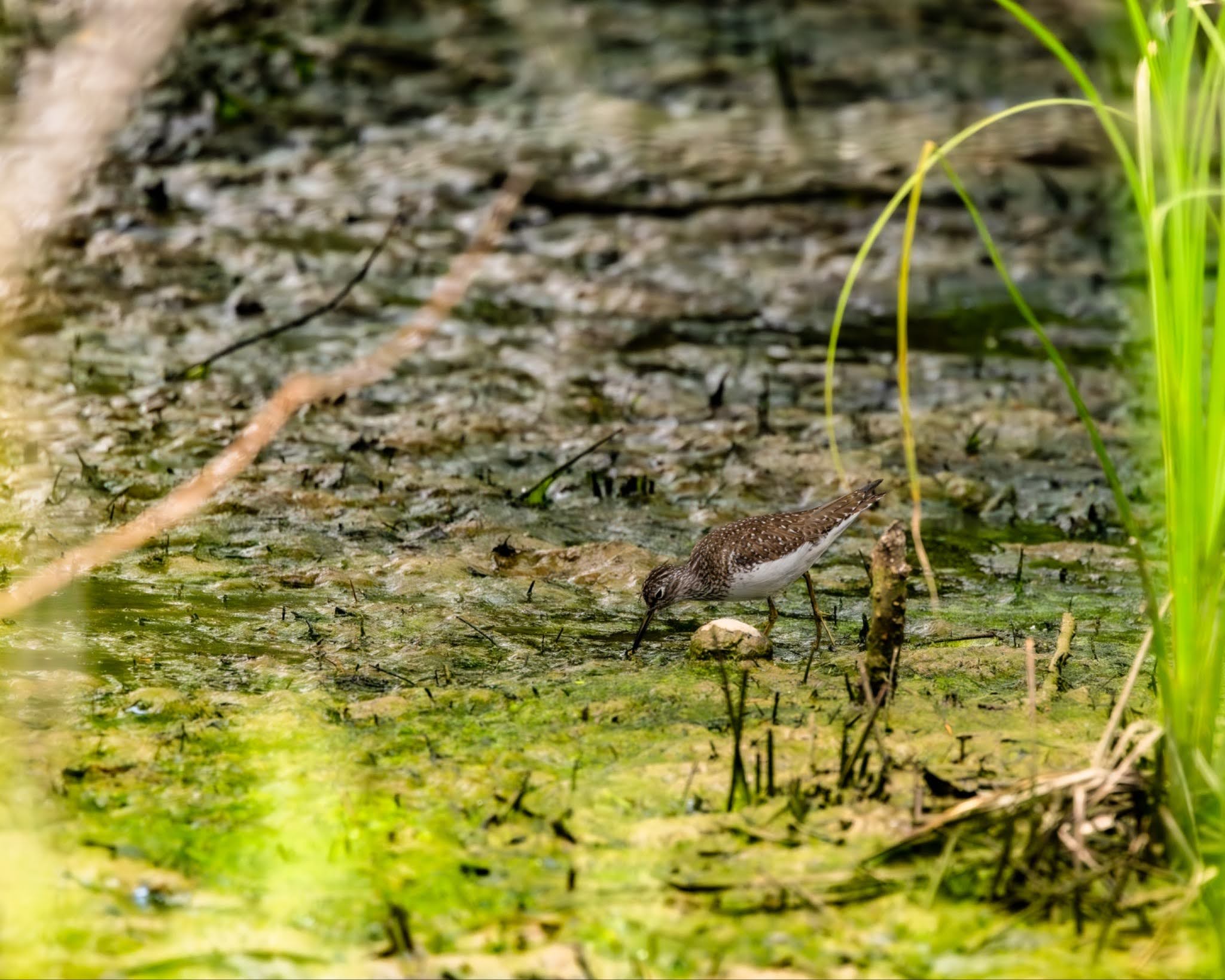
We were even graced by the presence of two of my personal favorite shorebirds: Solitary and Spotted Sandpipers. (I saw my first Solitary Sandpiper at Big Rock in Louisville’s Cherokee Park—you never forget the place you were when you see a particular bird species for the first time.)
The variety of species we saw—from songbirds and sparrows to shorebirds and raptors—shows why wetlands like this one are so important.
Photo: Solitary Sandpiper foraging the wetlands at the OLRDF site. Photo credit: Brandon McQueen
A haven for wildlife
The OLRDF site, completed in 2010, comprises nearly 800 acres of varying habitat types, including the 90-acre mitigated wetland we visited. Among these acres are detention ponds, mature tree stands, and many acres of maintained grassy areas.
The site provides essential habitat for Kentucky’s year-round birds—including our state bird, the Northern Cardinal—as well as those just passing through on their migratory journeys north or south, such as the warblers we saw that day.
Fluke pointed out the connection between bird species’ survival and habitat preservation and restoration: “Grasslands and wetlands are two of the most threatened habitat types in the U.S., and in turn, the birds that depend on these habitat types have declined, so it is even more important that we preserve [them.]”
The site also provides habitat for many other species of wildlife across trophic levels (which are the roles that organisms play in a food chain—including producers, primary consumers, and secondary consumers).
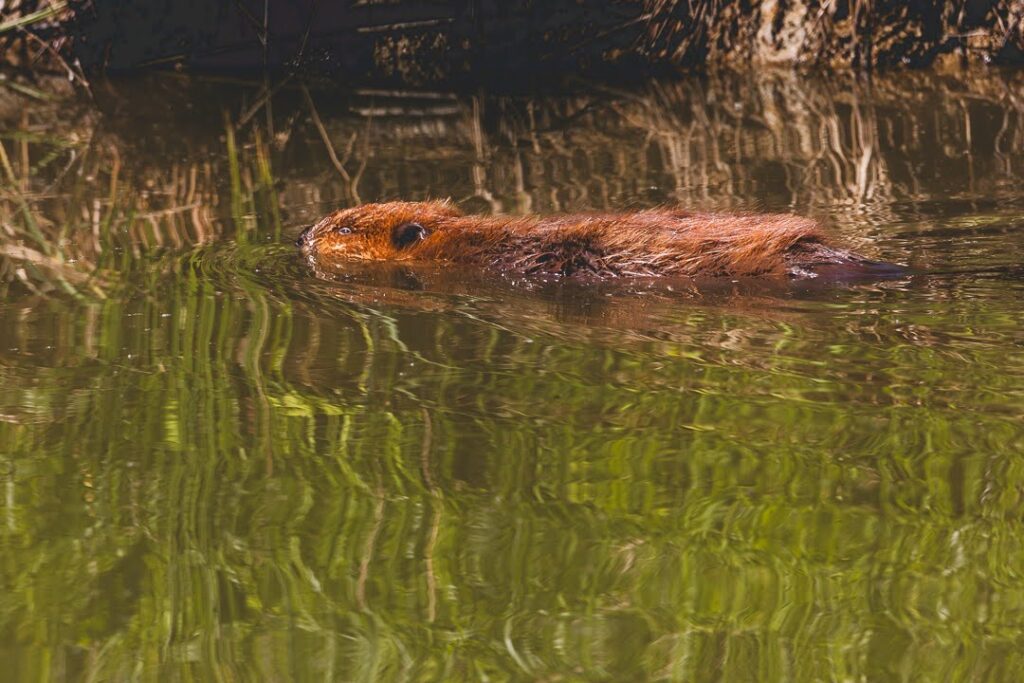
For example, our group came across another denizen of the wetlands on the way back to the lot: a North American Beaver, a charismatic megafauna that provides its own version of wetlands restoration: The dams that beavers build help control erosion, slow stormwater runoff, and sequester carbon (among other uses).
Photo: North American Beaver swimming in the OLRDF wetlands. Photo credit: Edmund Mount
Habitat management and conservation education
Osborne noted that the OLRDF site, along with almost 70 other WM sites across North America, are certified by the Wildlife Habitat Council.
This certification—a voluntary sustainability standard for biodiversity enhancement and conservation education activities on corporate landholdings—comes via Tandem Global, which advises the private sector on projects to advance biodiversity, promote habitat restoration, and enhance climate-change resilience, among other objectives.
SWS’ partnership with WMK allows SWS to maintain the native wetland ecosystem and create beneficial habitat for birds and other wildlife. Fluke and SWS monitor the site for invasive species management and overall ecosystem function, and WMK and SWS collaborate on multiple invasive species removal projects every year.
This partnership also has provided opportunities to host interactive educational projects with outside organizations and public groups, including the Girl Scouts of Kentuckiana, Louisville Parks and Recreation’s Berrytown Recreation Center, and—of course—LAS.
Fluke said a desire to share the success of the OLRDF’s wildlife habitat program—formally established in 2022—was the beginning of the educational outreach program.
“We hope we can inspire other individuals or workplaces to plan their landscapes to benefit native wildlife when possible,” Fluke said. “Even [actions] as basic as creating a small pollinator garden, choosing native species in landscape design, or sharing efforts by installing educational signage can remind people of the benefits of these projects for birds and other wildlife.”
Creating connection and sanctuary in ways big and small
This special opportunity gave us a chance to connect with the birds and contribute citizen-science data for World Migratory Bird Day. But it also gave us a chance to connect with each other during a time when connection can sometimes feel impossible, and it reminded us we’re all members of the same interconnected ecosystem—Solitary Sandpipers, Common Yellowthroats, North American Beavers, and humans alike.
Humans alone, however, shoulder the most responsibility when it comes to being caretakers of the Earth—the home we share with countless other species. We’ve made great strides in conservation—even if the need for conservation is due solely to our own destructive, careless, or uninformed actions—but we’ve also taken some steps backwards.
That doesn’t mean we should give up hope. We have to continue to take action in the face of doubt.
That starts with being humble and not taking up more space on Earth than we need, allowing other creatures their rightful place in the chain of life. And it continues by giving back to the planet any way we can, both big and small.
Supporting and advocating for habitat-restoration programs like this one is essential. After all, in many cases, what’s good for birds and other wildlife is good for humanity, too: We need clean water to drink, and enough of it, and wetlands are a highly effective natural way to ensure we have enough of both.
But even planting native in your little corner of the world makes an impact. Take the American Goldfinch who breakfasted at a coneflower in my yard one morning. My yard is small, and the coneflower takes up just a few feet of space, but for that goldfinch, it’s a sanctuary.
By planting a native flower, I provided nourishment for him and his mate—and by slowing down to watch them forage and appreciate our shared environment, I provided myself with a small but powerful way to reconnect with nature.
If you’re envious that LAS got the opportunity to visit this closed-to-the-public site and see the habitats that SWS and WMK are preserving for our feathered friends and other wildlife, we have good news for you.
You, too, can go “beyond the landfill”: SWS and WM are always looking for local groups interested in birding the OLRDF wetlands as part of their organized events. (Note: These birding opportunities are restricted to the wetlands portion of the landfill along the site’s southern boundary; the rest of the site is an active work zone and is not open for public viewing.)
If your group is interested in a guided birding walk at the OLRDF mitigation wetland, please contact Amy Osborn, WMK District Manager, at aosborn2@wm.com.
Featured photo: LAS volunteer Maria Tori scans the wetlands site for birds. Photo credit: Luke Pearson
No responses yet